
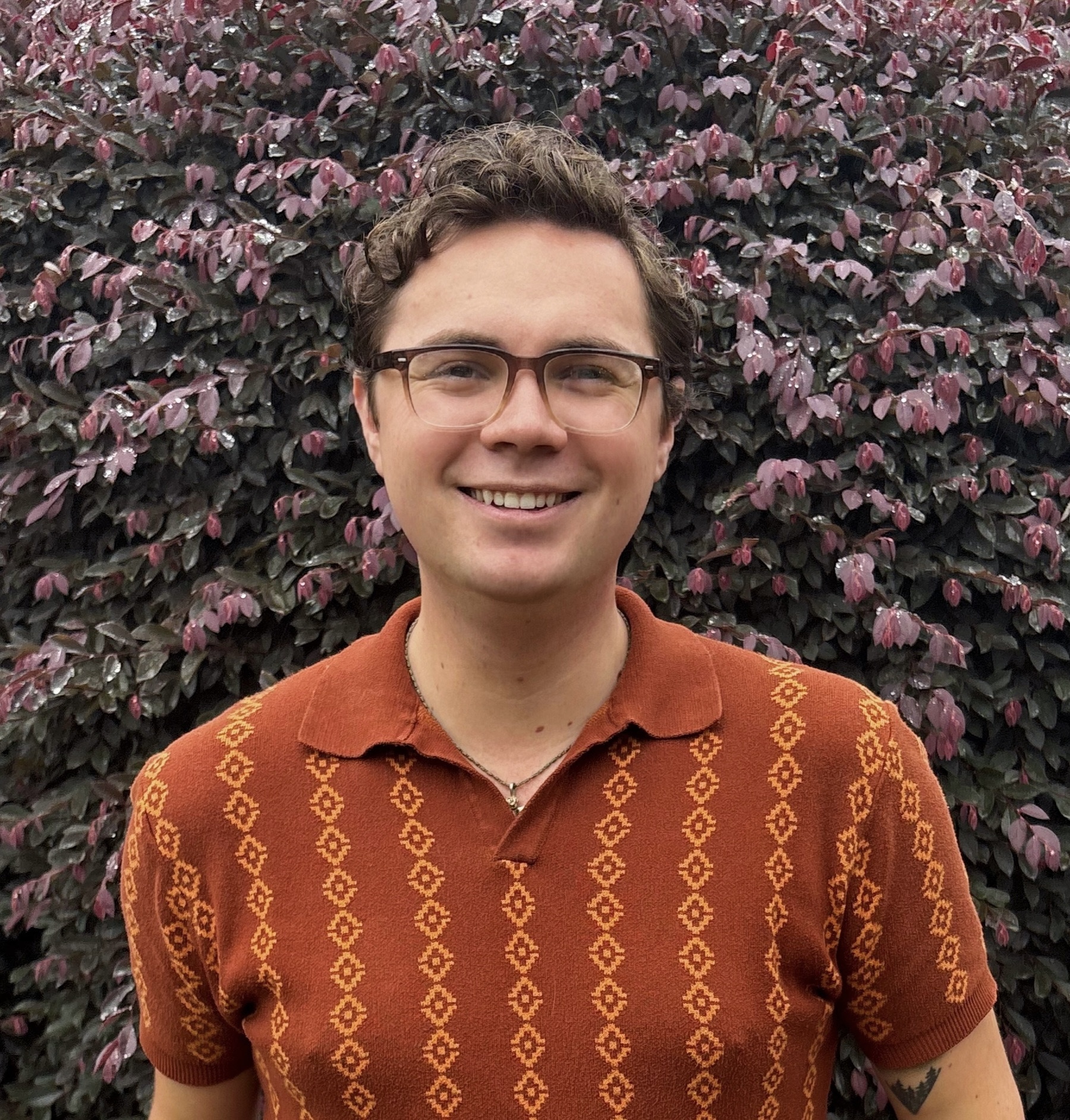
Jacob Barrett
Studying religion, analyzing sexual politics, and theorizing about intimate governance
(and probably listening to Taylor Swift while doing it)
About Me

I am a PhD candidate in the Department of Religious Studies at the University of North Carolina at Chapel Hill, specializing in Religion and Culture. My research examines how the American state governs intimate life through the intertwined discourses of religion and sexuality, revealing how concepts like religious freedom, marriage, and parental rights function as technologies of governance rather than neutral protections of individual liberty.
My dissertation, “Intimately Governed: Sex, Religion, and the First Amendment,” develops a genealogy of religious freedom alongside three concepts central to its operation – proper marriage, parental rights, and personhood – revealing how seemingly private spheres of intimacy function as technologies of governance. Through paired analysis of landmark Supreme Court cases and contemporary controversies, I trace how these supposedly stable and universal values operate flexibly to serve changing state interests. By juxtaposing historical precedents with present-day deployments, I demonstrate how religious freedom operates not as a protection from state power but as a mechanism through which the state produces and regulates legitimate citizenship. By bringing critical religious studies into conversation with queer theory, I show how current anxieties about family values and Christian nationalism aren’t sudden manifestations of religious extremism but ongoing patterns where the state’s interventions into intimate life appear as the defense of cherished democratic principles.
My research contributes to multiple fields including American religious history (particularly evangelicalism and the Christian Right), religious freedom jurisprudence, critical theory and method in religious studies, and gender and sexuality studies. I’m particularly interested in how queer theoretical frameworks can illuminate the governing functions of both religion and law in American society.
Originally from Colorado Springs, I completed a B.A. in Philosophy & Religion with a minor in Biology from Nebraska Wesleyan University (2020), where I developed a deep appreciation for liberal arts education through extensive involvement in student life and governance. I completed my M.A. in Religion in Culture from the University of Alabama (2022), where I also earned the certificate in Advanced Online Pedagogy and developed expertise in digital humanities—both public-facing work (video production, podcasting, web design) and computational analysis (text analysis, network analysis, data visualization). At the University of North Carolina at Chapel Hill, I’ve completed the Digital Humanities Graduate Certificate while teaching courses across Religious Studies, Women’s and Gender Studies, and the university’s interdisciplinary Triple I program.
Beyond my academic work, I serve as Director of Marketing and Publicity for the American Academy of Religion – Southeast Region, ensuring effective communication between regional leadership and members. I’m an active member of the American Academy of Religion’s Graduate Student Committee, and am currently running for the Student Director position. Please read the AAR GSC’s open letter series about the state of graduate students in our field! My commitment to the field extends through various service roles with organizations, including the North American Association for the Study of Religion (NAASR), the Center for the Study of Evangelicalism at the University of Colorado – Colorado Springs, and contributions to public scholarship through the New Books Network.
Why “The Reluctant Americanist”?
“The Reluctant Americanist” might seem like a strange name for this website, especially given that my work focuses on the United States and “reluctant” is not an adjective an academic would typically want to be associated with. So, how did the name come to be? To find the answer to that question, we have to go back to the first week of my M.A. program. I was eager and ambitious as early graduate students are, and I thought I knew what I wanted to study. The first week of classes, I emailed a professor I wanted to work with and set up a meeting to, as I put it, “chat about my research interests and advice in starting to look at PhD programs.” We met, and after I gave my whole spiel about wanting to do some big research project that included examples from numerous nations, traditions, and time periods (remember when I said I was eager and ambitious?) the professor began asking me questions about what I was interested in. I spent the next thirty minutes dodging their attempts to get me to express an interest in the United States that was very clearly there. Almost every answer I gave went something like, “Well, you know how in the United States this happens? What if I studied that but not in America?” After a while, the professor sat for a minute and offered me this:
“I think you are a reluctant Americanist.”
I remember sitting there not quite sure how to respond because I didn’t know what that meant, but as soon as the words hit me they felt right. I began jokingly referring to myself as a reluctant Americanist when people would ask what kind of scholar I wanted to be and was always met with a laugh. I wore that label and parroted it for several months after that meeting, never entirely sure what it meant. Over time, though, as my project took shape and I engaged more deeply with critical approaches to religious freedom, I began to develop an explanation that framed my work in a way that I felt accurately described what I wanted to do while also making sense of my professor’s initial comment.
I realized that much of the scholarship on American religious freedom either celebrates it as a foundational achievement of liberal democracy or critiques its inconsistent application while still treating it as an inherently noble ideal – both approaches reinforcing a kind of American exceptionalism. Meanwhile, the most critical work on religious freedom tends to focus on international contexts, examining how it functions as a tool of empire, a technique of governance, or a mechanism for managing difference in postcolonial settings. I was an Americanist, but only because I wanted to bring these critical insights home (in the style of Elizabeth Shakman Hurd and Winnifred Sullivan’s At Home and Abroad) to examine how religious freedom operates as a governing technology within the United States itself, not as a neutral principle to be properly applied but as a mechanism through which the state produces and regulates its citizens.
And so, I am “The Reluctant Americanist” – committed to taking the United States seriously as a site of inquiry, yet resistant to the exceptionalist assumptions that often accompany that focus. My reluctance is methodological and theoretical: it keeps me attentive to how my work participates in broader conversations about power, governance, and modernity rather than treating American religious freedom as a sui generis phenomenon. It reminds me that studying the United States is valuable not because America is uniquely interesting, but because examining how power operates in this particular context can illuminate broader dynamics of how modern liberal states govern difference, manage populations, and maintain their authority through the very freedoms they claim to protect.
 Jacob Barrett - The Reluctant Americanist